
What Is Machine Learning and How Does It Work? A Complete Beginner’s Guide (2026)

Machine Learning is one of the most powerful technologies shaping our world today. From Google search results and Netflix recommendations to self-driving cars and medical diagnosis, machine learning is working behind the scenes everywhere.
But what is machine learning, how does it actually work, and why is it so important in 2026?
This in-depth guide will explain machine learning from scratch, even if you have no technical background. By the end of this article, you’ll clearly understand:
-
What machine learning is
-
How machine learning works step by step
-
Types of machine learning
-
Popular machine learning algorithms
-
Real-world applications of machine learning
-
Who a machine learning engineer is and how to become one
Introduction to Machine Learning
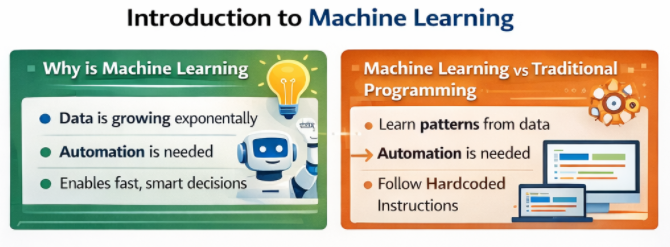
In the past, computers followed strict rules written by humans. If you wanted software to perform a task, you had to tell it exactly what to do.
Machine learning changes this completely.
Instead of manually programming rules, we allow computers to learn patterns from data and improve their performance automatically.
Why Is Machine Learning Important Today?
Machine learning is essential because:
-
Data is growing exponentially
-
Manual analysis is no longer possible
-
Businesses need faster and smarter decisions
-
Automation is critical for scalability
According to industry trends, over 90% of modern applications use some form of machine learning.
What Is Machine Learning?
Definition of Machine Learning
Machine learning is a subset of artificial intelligence that enables computers to learn from data and make predictions or decisions without being explicitly programmed.
In simple words:
Machine learning allows machines to learn from experience.
Example of Machine Learning
-
You search for shoes online
-
You start seeing shoe ads everywhere
-
That’s machine learning analyzing your behavior
Machine Learning vs Artificial Intelligence
Many beginners confuse AI and machine learning.
| Artificial Intelligence | Machine Learning |
|---|---|
| Broad concept | Subset of AI |
| Mimics human intelligence | Learns from data |
| Rule-based + learning | Data-driven only |
👉 AI is the goal. Machine learning is one way to achieve it.
How Does Machine Learning Work? (Step by Step)
Understanding how machine learning works is key to mastering the concept.
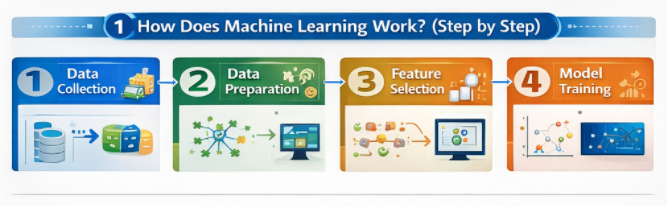
Step 1: Data Collection
Machine learning starts with data.
Examples:
-
Images
-
Text
-
Numbers
-
Videos
-
Audio
More data = better learning.
Step 2: Data Preparation
Raw data is messy.
This step includes:
-
Removing duplicates
-
Handling missing values
-
Normalizing data
-
Converting text to numbers
80% of machine learning work is data preparation.
Step 3: Feature Selection
Features are important characteristics of data.
Example (house price prediction):
-
Location
-
Size
-
Number of rooms
Good features = accurate models.
Step 4: Model Training
The machine learning algorithm:
-
Analyzes patterns
-
Finds relationships
-
Adjusts parameters
This is where the “learning” happens.
Step 5: Model Evaluation
The model is tested using unseen data.
Metrics used:
-
Accuracy
-
Precision
-
Recall
-
F1 Score
Step 6: Prediction & Deployment
Once trained, the model:
-
Makes predictions
-
Is deployed into real-world applications
Role of Data in Machine Learning
Data is the fuel of machine learning.
Types of Data
-
Structured Data: Tables, spreadsheets
-
Unstructured Data: Images, videos, text
-
Semi-structured Data: JSON, XML
Why Data Quality Matters
Poor data leads to:
-
Biased models
-
Incorrect predictions
-
Business losses
Types of Machine Learning
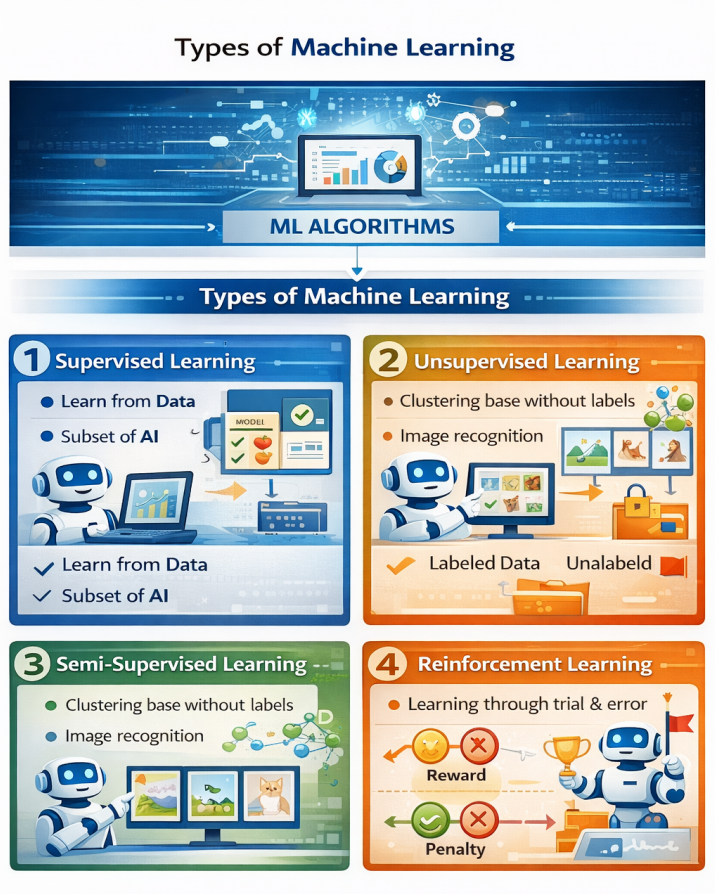
There are four main types of machine learning.
1. Supervised Learning
Supervised learning uses labeled data.
How It Works
-
Input data + correct output
-
Model learns mapping
Examples
-
Email spam detection
-
House price prediction
-
Medical diagnosis
Popular Algorithms
-
Linear Regression
-
Logistic Regression
-
Decision Trees
2. Unsupervised Learning
Unsupervised learning uses unlabeled data.
Purpose
-
Discover hidden patterns
-
Group similar data
Examples
-
Customer segmentation
-
Market basket analysis
Popular Algorithms
-
K-Means Clustering
-
Hierarchical Clustering
3. Semi-Supervised Learning
Used when:
-
Small labeled data
-
Large unlabeled data
Common in:
-
Image recognition
-
Speech processing
4. Reinforcement Learning
Learning through trial and error.
Key Concepts
-
Agent
-
Environment
-
Reward
-
Penalty
Examples
-
Self-driving cars
-
Game-playing AI (AlphaGo)
-
Robotics
Machine Learning Algorithms Explained
1. Linear Regression
Used for predicting continuous values.
Example:
-
Salary prediction
-
Temperature forecasting
2. Logistic Regression
Used for classification.
Example:
-
Spam or not spam
-
Yes or no decisions
3. Decision Trees
Tree-like structure for decision-making.
Advantages:
-
Easy to understand
-
Visual interpretation
4. Random Forest
Combination of multiple decision trees.
Benefits:
-
Higher accuracy
-
Less overfitting
5. Support Vector Machines (SVM)
Separates data using hyperplanes.
Used in:
-
Text classification
-
Image recognition
6. K-Nearest Neighbors (KNN)
Classifies data based on similarity.
Simple yet powerful.
7. Neural Networks
Inspired by the human brain.
Used in:
-
Image recognition
-
Speech recognition
-
Chatbots
What Is Machine Learning Used For?
Machine learning is used in almost every industry.
Healthcare
-
Disease prediction
-
Medical imaging
-
Drug discovery
Finance
-
Fraud detection
-
Credit scoring
-
Algorithmic trading
E-Commerce
-
Product recommendations
-
Customer behavior analysis
Marketing
-
Targeted advertising
-
Customer segmentation
-
Lead scoring
Autonomous Vehicles
-
Object detection
-
Path planning
Cybersecurity
-
Threat detection
-
Anomaly detection
Who Is a Machine Learning Engineer?
A machine learning engineer builds, trains, and deploys ML models.
Responsibilities
-
Data preprocessing
-
Model selection
-
Training & optimization
-
Deployment & monitoring
Skills Required
-
Python programming
-
Statistics & probability
-
Machine learning algorithms
-
Libraries: TensorFlow, PyTorch, Scikit-learn
Machine Learning Engineer Salary (2026)
-
Entry-level: High demand
-
Mid-level: Strong growth
-
Senior roles: Premium salaries globally
Benefits of Machine Learning
-
Automation of complex tasks
-
Improved decision-making
-
Scalability
-
Cost efficiency
Challenges and Limitations
Bias in Data
Models learn biases from data.
Privacy Concerns
Sensitive data handling.
High Resource Requirement
Training large models is expensive.
Future of Machine Learning (2026 & Beyond)
Key trends:
-
AutoML
-
Edge AI
-
Explainable AI
-
Responsible AI
Machine learning will become more accessible, ethical, and powerful.
Frequently Asked Questions (FAQs)
What is machine learning in simple words?
Machine learning teaches computers to learn from data and make decisions automatically.
How does machine learning work step by step?
Data → Training → Evaluation → Prediction.
Is machine learning hard to learn?
No. With the right roadmap, beginners can start easily.
What is machine learning used for?
From recommendations to self-driving cars.
Conclusion
Machine learning is no longer the future — it is the present.
Understanding what machine learning is and how it works opens doors to:
-
High-paying careers
-
Smarter businesses
-
Advanced technology development
If you’re planning to learn AI or machine learning in 2026, this is the best time to start.
