Deep Learning Explained for Beginners: Concepts, Frameworks, and AI Uses

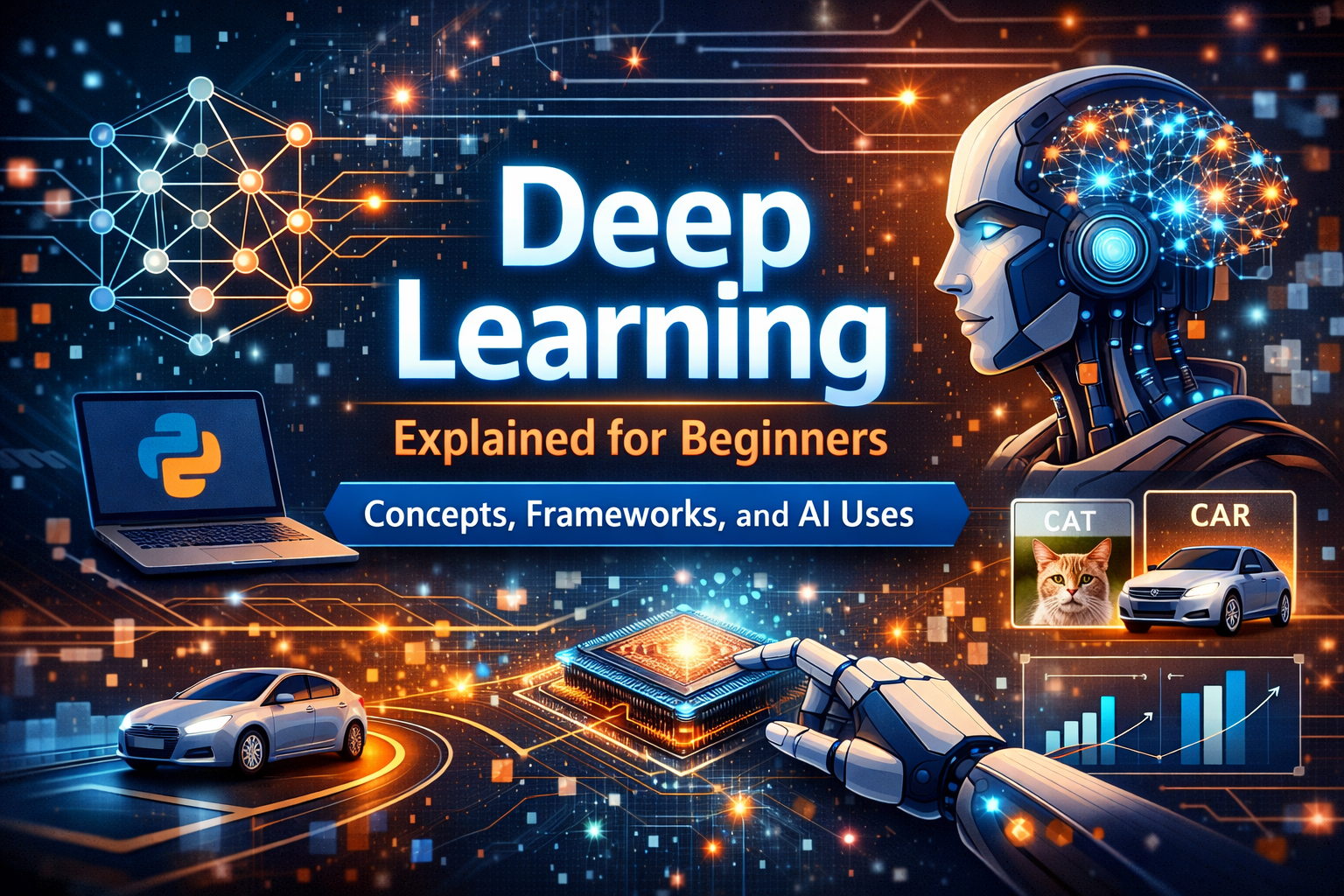
Artificial Intelligence is evolving rapidly, and at the heart of this transformation lies deep learning. From voice assistants and recommendation engines to medical diagnosis and self-driving cars, deep learning AI is quietly powering the smartest technologies we use every day.
For beginners, deep learning can feel complex and technical. But the truth is, once explained step by step, it becomes easy to understand and exciting to learn. This guide is designed specifically for beginners who want to understand what is deep learning, how it works, how it differs from machine learning, and how to start learning it from scratch.
📌 What Is Deep Learning?
Deep learning is a subset of machine learning that uses neural networks with multiple layers to learn from large amounts of data and make intelligent decisions automatically.
Why Deep Learning Matters in Today’s Worldwhat is deep learning
Deep learning is no longer a future concept—it is already shaping how businesses operate and how people interact with technology. Organizations rely on deep learning AI to analyze massive datasets, automate complex tasks, and deliver personalized experiences.
Learning deep learning today means preparing yourself for tomorrow’s technology-driven world.
Why You Should Learn Deep Learning Today
Learning deep learning can help you:
-
Build intelligent AI applications
-
Understand how modern AI systems work
-
Work with advanced tools like image and language models
-
Access high-paying AI and ML career opportunities
-
Stay relevant in a rapidly evolving job market
The best part? Anyone can learn deep learning, even beginners with no prior AI experience.
📌 How to Learn Deep Learning (Quick Answer)
To learn deep learning, start with AI basics, learn Python, understand machine learning, study neural networks, explore deep learning frameworks, and build real-world projects consistently.
📌 What Is Deep Learning?
What Is Deep Learning in Simple Words?
Many beginners ask, what is deep learning, and how it fits into artificial intelligence.
Deep learning is a technique that teaches computers to learn from experience. It uses artificial neural networks inspired by the human brain to process data and recognize patterns.
Instead of following fixed rules, deep learning systems learn automatically by analyzing large amounts of data.
Deep Learning Explained with a Simple Example
Think about how a child learns to recognize a cat. The child sees many pictures of cats, notices patterns like ears, eyes, and tails, and gradually learns what a cat looks like.
Deep learning works the same way. A deep learning model sees thousands or millions of examples and learns patterns on its own
📌 Deep Learning Explained Simply
Deep learning allows machines to learn patterns from data using layered neural networks, improving accuracy as more data is provided.
Deep Learning AI: The Brain Behind Modern Artificial Intelligence
Deep learning AI is the core technology that enables machines to see, hear, speak, and understand language. While artificial intelligence is a broad concept, deep learning gives AI its true intelligence.
How Deep Learning AI Works
Deep learning AI systems work by:
-
Taking raw data as input
-
Processing it through multiple neural network layers
-
Extracting meaningful features automatically
-
Producing predictions or decisions
With more data and training, deep learning AI becomes more accurate over time.
Real-Life Applications of Deep Learning AI
Deep learning AI is used in many everyday applications:
-
Face recognition on smartphones
-
Voice assistants like Alexa and Siri
-
Recommendation systems on YouTube and Netflix
-
Medical image analysis
-
Autonomous vehicles
These applications rely on deep learning because traditional algorithms cannot handle such complex data.
Artificial Intelligence vs Machine Learning vs Deep Learning

Understanding the Difference Clearly
Beginners often confuse these terms, so let’s break them down simply.
📌 AI vs ML vs Deep Learning
-
Artificial Intelligence (AI): The overall concept of making machines intelligent
-
Machine Learning (ML): A subset of AI where systems learn from data
-
Deep Learning: A subset of ML that uses deep neural networks
👉 AI is the big umbrella, machine learning is a branch, and deep learning is the most advanced branch.
Deep Learning vs Machine Learning
Understanding deep learning vs machine learning is important when deciding which approach to use.
Key Differences Between Deep Learning and Machine Learning
| Feature | Machine Learning | Deep Learning |
|---|---|---|
| Feature extraction | Manual | Automatic |
| Data requirement | Small to medium | Large datasets |
| Accuracy | Moderate | Very high |
| Complexity | Lower | Higher |
| Hardware needs | Low | High (GPUs) |
When to Use Deep Learning vs Machine Learning
-
Use machine learning for simpler prediction problems
-
Use deep learning for images, videos, speech, and text
Deep learning vs machine learning is not about which is better—it’s about which is more suitable for the problem.
📌 Deep Learning vs Machine Learning
Deep learning automatically learns features from data using neural networks, while machine learning often relies on manually selected features.
Who Can Learn Deep Learning?
Can Beginners Learn Deep Learning?
Yes. Beginners can learn deep learning by starting with the basics and following a structured roadmap. No advanced degree is required.
Can Non-Programmers Learn Deep Learning?
Yes. Many deep learning AI tools are beginner-friendly. However, learning basic Python will help you progress faster.
Is Deep Learning a Good Career Choice?
Absolutely. Deep learning professionals are in high demand across industries such as healthcare, finance, robotics, and technology.
Skills Required to Learn Deep Learning

Do You Need Coding for Deep Learning?
Basic coding knowledge is helpful. You don’t need to be an expert, but understanding Python basics is recommended.
Is Math Required for Deep Learning?
Only basic math is required at the beginning. Advanced math concepts can be learned gradually.
Best Programming Language for Deep Learning
📌 Best Language for Deep Learning
-
Python (best for beginners)
-
R (used in research)
-
Java (enterprise-level systems)
👉 Python is the most popular and beginner-friendly choice.
📌 Deep Learning Frameworks Explained
What Are Deep Learning Frameworks?
Deep learning frameworks are tools that help developers create, train, and deploy deep learning models efficiently. They handle complex neural network computations behind the scenes.
Deep learning frameworks make AI development faster, easier, and more scalable.
Why Deep Learning Frameworks Are Important
Without deep learning frameworks, building neural networks would require writing thousands of lines of mathematical code. Frameworks simplify this process and allow developers to focus on creativity and problem-solving.
Popular Deep Learning Frameworks
Some commonly used deep learning frameworks support:
-
Neural network building
-
GPU acceleration
-
Model training and testing
-
AI deployment
These deep learning frameworks are widely used in industry and research.
How to Choose the Right Deep Learning Framework
Choose a deep learning framework based on:
-
Ease of learning
-
Community support
-
Performance needs
-
Deployment options
Beginners should choose frameworks with strong documentation and tutorials.
📌 Step-by-Step Roadmap to Learn Deep Learning

Step 1: Learn AI and Deep Learning Basics
Start by understanding:
-
What is deep learning
-
How deep learning AI works
-
Real-world use cases
This builds a strong foundation.
Step 2: Learn Python Programming
Python is essential for deep learning.
Learn:
-
Variables and data types
-
Loops and functions
-
Basic libraries
Step 3: Understand Machine Learning Concepts
Before diving deep, understand:
-
Supervised learning
-
Unsupervised learning
-
Model training and evaluation
This helps clarify deep learning vs machine learning.
Step 4: Learn Neural Networks
Now focus on deep learning concepts:
-
Artificial neurons
-
Hidden layers
-
Activation functions
This is the core of deep learning AI.
Step 5: Practice with Deep Learning Projects
📌 Beginner Deep Learning Projects
-
Image classification
-
Handwritten digit recognition
-
AI chatbot
-
Text summarization
Projects help convert theory into real skills.
Best Free Resources to Learn Deep Learning
Free Learning Options
-
Beginner deep learning tutorials
-
Interactive notebooks
-
Practice datasets
Best Tools for Beginners
-
Cloud-based coding platforms
-
AI experimentation tools
-
Visualization tools
These resources help beginners learn deep learning faster.
📌 How Long Does It Take to Learn Deep Learning?
Time Required for Beginners
-
Deep learning basics: 2–3 months
-
Python + ML basics: 3–6 months
Time Required for Career-Ready Skills
-
Job-ready deep learning skills: 6–12 months
(depending on practice and consistency)
Career Options After Learning Deep Learning
Deep Learning Engineer
Builds and deploys deep learning AI models.
AI Engineer
Designs intelligent systems using deep learning.
Data Scientist
Applies deep learning to analyze complex data.
AI Researcher
Improves deep learning algorithms and architectures.
Common Mistakes Beginners Make While Learning Deep Learning
Trying to Learn Everything at Once
Deep learning is vast. Focus on one step at a time.
Ignoring Fundamentals
Strong basics make advanced learning easier.
Avoiding Practical Projects
Hands-on practice is essential.
📌 Deep Learning – Common Beginner Questions
Q: Is deep learning difficult for beginners?
No. With a step-by-step approach, deep learning becomes easy to understand.
Q: Can I learn deep learning without coding?
You can learn concepts without coding, but Python helps for real projects.
Q: Is deep learning a good career in 2026?
Yes. Deep learning AI careers are growing rapidly worldwide.
Conclusion: Start Your Deep Learning Journey Today
Deep learning is transforming artificial intelligence and redefining how machines interact with the world. By understanding what is deep learning, learning how deep learning frameworks work, and clearly knowing the difference between deep learning vs machine learning, beginners can confidently enter the AI field.
Deep learning AI may seem complex at first, but with consistent learning, hands-on projects, and a structured roadmap, anyone can master it. The future belongs to those who understand deep learning—and now is the perfect time to start.
