

What Is Python for AI?
Python for AI refers to using the Python programming language to build artificial intelligence applications such as machine learning models, data analysis systems, neural networks, and automation tools. Python is preferred for AI because of its simple syntax, powerful libraries, and strong community support.
Artificial Intelligence (AI) is transforming every industry—from healthcare and finance to marketing and entertainment. Behind most modern AI systems lies one powerful programming language: Python.
If you’re a beginner wondering how to learn Python for AI, this guide is for you.
How to Learn Python for AI (Step-by-Step)
To learn Python for AI, follow these steps:
-
Learn Python basics like variables, loops, and functions
-
Practice Python programming with small projects
-
Learn data handling using NumPy and Pandas
-
Understand machine learning with Scikit-learn
-
Move to deep learning using TensorFlow or PyTorch
In this complete roadmap, you’ll learn:
-
What Python is
-
Why Python is best for AI
-
Python basics you must master
-
How long it takes to learn Python
-
A step-by-step Python learning path for AI beginners
No prior coding experience is required.
What Is Python?
What Is Python Programming?
Python is a high-level, interpreted programming language known for its simple syntax and readability. It allows developers to write fewer lines of code compared to many other languages.
Python programming focuses on:
-
Easy-to-read code
-
Rapid development
-
Strong community support
Because of these qualities, Python is widely used in AI, machine learning, data science, automation, and web development.
Is Python Object Oriented?
Yes, Python is an object-oriented programming (OOP) language.
This means Python supports:
-
Classes
-
Objects
-
Inheritance
-
Polymorphism
-
Encapsulation
Object-oriented concepts help AI developers build scalable, reusable, and maintainable systems, especially when working with complex models and data pipelines.
What Is Python Used For?
Many beginners ask: what is Python used for?
Python is used in:
-
Artificial Intelligence & Machine Learning
-
Data Science & Data Analysis
-
Automation & scripting
-
Web development
-
Game development
-
Cybersecurity
-
Internet of Things (IoT)
In AI specifically, Python is used to:
-
Train machine learning models
-
Analyze massive datasets
-
Build neural networks
-
Create chatbots and recommendation systems
Why Learn Python for AI?
Why Python Is the Best Language for AI
Python dominates AI development for several reasons:
| Feature | Why Python Wins for AI |
|---|---|
| Easy Syntax | Beginner-friendly and readable |
| AI Libraries | NumPy, Pandas, TensorFlow |
| Community | Huge global support |
| Industry Use | Used by Google, Meta, OpenAI |
| Speed | Faster AI development |
-
Simple Syntax
Python code looks almost like English, making it easy for beginners. -
Massive AI Libraries
Python has libraries like NumPy, Pandas, Scikit-learn, TensorFlow, and PyTorch. -
Strong Community Support
Millions of developers contribute tutorials, forums, and open-source tools. -
Industry Adoption
Companies like Google, Meta, Netflix, and OpenAI rely heavily on Python.
Python vs Other Languages for AI
-
Python vs Java: Python is easier and faster to prototype AI models.
-
Python vs C++: C++ is faster but far more complex.
-
Python vs R: Python is better for production-ready AI systems.
This is why almost every beginner AI roadmap starts with learn Python for AI.
Python Basics You Must Learn First
Before jumping into AI libraries, you must understand Python basics.
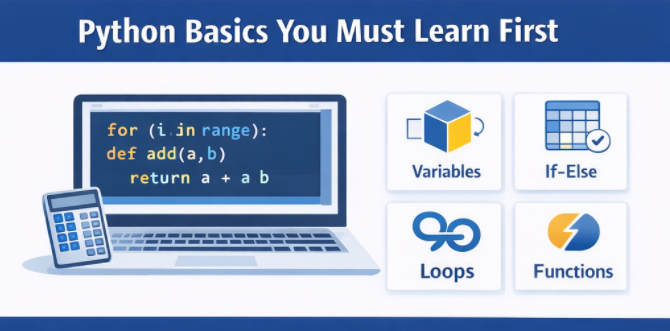
Python Basics for AI Beginners
-
Variables and data types
-
Conditional statements
-
Loops (for, while)
-
Functions
-
Data structures (list, dict, tuple)
Python Syntax and Variables
Python uses indentation instead of curly braces.
Example:
Key concepts:
-
Variables
-
Data types (int, float, string, boolean)
-
Indentation rules
Control Flow in Python
Control flow helps your program make decisions.
You’ll learn:
-
if–else statements
-
for loops
-
while loops
Example:
Functions in Python
Functions help reuse code.
Example:
Functions are heavily used in AI to:
-
Process data
-
Train models
-
Evaluate predictions
How to Start Python Programming
How to Install Python
To begin Python programming:
-
Download Python from the official website
-
Install it on Windows, macOS, or Linux
-
Choose an editor like:
-
VS Code
-
PyCharm
-
Jupyter Notebook
-
How to Check Python Version
Many AI libraries require a specific Python version.
To check Python version:
or
This step is critical before installing AI tools.
Your First Python Program
Your first Python program usually looks like this:
This confirms Python is installed and working correctly.
How to Comment in Python (Very Important)
Single-Line Comments in Python
Use # for single-line comments.
Example:
Multi-Line Comments in Python
Python uses docstrings for multi-line comments.
Example:
Good commenting is essential when working on AI projects with teams.
Core Python Concepts for AI
Data Structures in Python
Python offers powerful data structures:
-
Lists
-
Tuples
-
Dictionaries
-
Sets
These structures help store and manipulate AI datasets efficiently.
File Handling in Python
AI models rely on data files.
Python allows you to:
-
Read CSV files
-
Write data to files
-
Handle large datasets
Error Handling in Python
Error handling helps prevent program crashes.
Example:
This skill is crucial when building robust AI applications.
Python Libraries for Artificial Intelligence
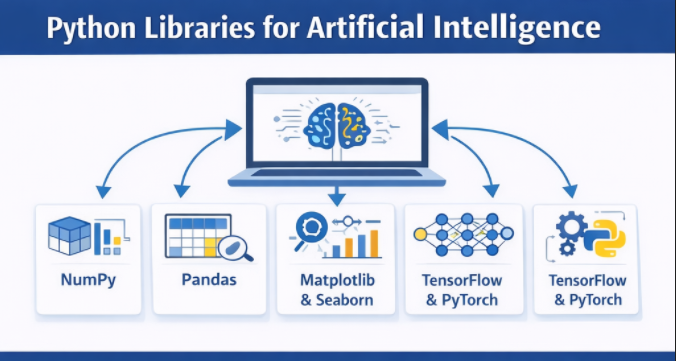
NumPy for Numerical Computing
NumPy provides support for:
-
Arrays
-
Matrices
-
Mathematical operations
It is the backbone of AI computations.
Pandas for Data Analysis
Pandas is used for:
-
Cleaning datasets
-
Handling missing values
-
Data analysis
Almost every AI project uses Pandas.
Matplotlib & Seaborn for Visualization
These libraries help visualize data using:
-
Graphs
-
Charts
-
Plots
Visualization improves model understanding.
Scikit-Learn for Machine Learning
Scikit-learn offers:
-
Regression
-
Classification
-
Clustering
-
Model evaluation tools
It’s perfect for beginners learning machine learning.
TensorFlow & PyTorch for Deep Learning
These libraries power:
-
Neural networks
-
Deep learning models
-
Computer vision
-
Natural language processing
Step-by-Step Python Learning Roadmap for AI
Step 1 – Learn Python Basics
Focus on:
-
Syntax
-
Variables
-
Loops
-
Functions
Step 2 – Master Python Data Handling
Learn:
-
Lists and dictionaries
-
File handling
-
Error handling
Step 3 – Learn Data Analysis with Python
Work with:
-
NumPy
-
Pandas
-
Data visualization
Step 4 – Start Machine Learning with Python
Build ML models using:
-
Scikit-learn
-
Real datasets
Step 5 – Move to Deep Learning
Learn:
-
TensorFlow or PyTorch
-
Neural networks
-
AI projects
How to Learn Python Faster (Pro Tips)
Best Python Learning Resources
-
Official Python documentation
-
Online courses
-
Practice platforms like coding challenges
Practice Python with AI Projects
Build projects like:
-
Spam classifier
-
Recommendation system
-
Chatbot
Practice is the fastest way to master Python programming.
How Long Does It Take to Learn Python for AI?
Python Learning Timeline for AI Beginners
Python learning timeline:
-
1 month: Python basics
-
3 months: Intermediate Python + data analysis
-
6 months: AI and machine learning projects
Factors That Affect Learning Speed
-
Daily practice time
-
Prior technical background
-
Project-based learning
Consistency matters more than speed.
Common Beginner Mistakes in Python Programming
Skipping Python Basics
AI beginners often jump straight to libraries without mastering fundamentals.
Not Practicing Enough
Watching tutorials alone is not enough.
Jumping into AI Too Early
Strong Python basics lead to faster AI learning.
Career Opportunities After Learning Python for AI
AI Engineer
Designs and deploys AI systems.
Machine Learning Engineer
Builds predictive ML models.
Data Scientist
Analyzes data to extract insights.
Python Developer
Develops applications using Python.
Python for AI opens doors to high-paying global careers.
FAQs About Learning Python for AI
What Is Python Used For?
Python is used for artificial intelligence, machine learning, data science, web development, automation, and software development.
Is Python Object Oriented?
Yes, Python is an object-oriented programming language that supports classes, objects, inheritance, and polymorphism.
How Long Does It Take to Learn Python for AI?
It usually takes 3 to 6 months to learn Python for AI, depending on daily practice time and prior programming experience.
How to Check Python Version?
You can check the Python version by running
python --versionorpython3 --versionin the command line.
How to Comment in Python?
In Python, single-line comments use the
#symbol, and multi-line comments are written using triple quotes (""" """).
Final Thoughts: Start Your Python for AI Journey Today
Learning Python for AI is one of the best career decisions you can make in today’s tech-driven world.
Start with:
-
Python basics
-
Consistent practice
-
Small AI projects
Over time, you’ll build the confidence to create real-world AI solutions.
The journey may feel long, but every expert AI developer started exactly where you are now.
Start today. Stay consistent. Build the future with Python and AI. 🚀
