
Artificial Intelligence (AI) is no longer just a buzzword—it’s shaping how we work, learn, and live. From ChatGPT answering questions to AI recommending videos, music, and products, AI is everywhere.
If you’re wondering how to learn AI and where to start as a beginner, this guide is for you.
📌 How to Learn AI
To learn AI, start by understanding basic AI concepts, learn Python, study machine learning fundamentals, explore Generative AI tools, and build simple AI projects consistently.
This article explains how to learn AI step by step, using simple language, practical examples, and a clear roadmap—no prior experience required.
Why You Should Learn AI Today
AI skills are in high demand across industries like technology, healthcare, finance, marketing, and education. Learning AI can help you:
-
Future-proof your career
-
Automate repetitive tasks
-
Understand modern tools like ChatGPT and AI image generators
-
Unlock high-paying job opportunities
The best part? Anyone can learn AI, even without a technical background.
📌What Is Artificial Intelligence?
Artificial Intelligence (AI) is the ability of machines to learn from data, make decisions, and perform tasks that normally require human intelligence.
AI Explained in Simple Words
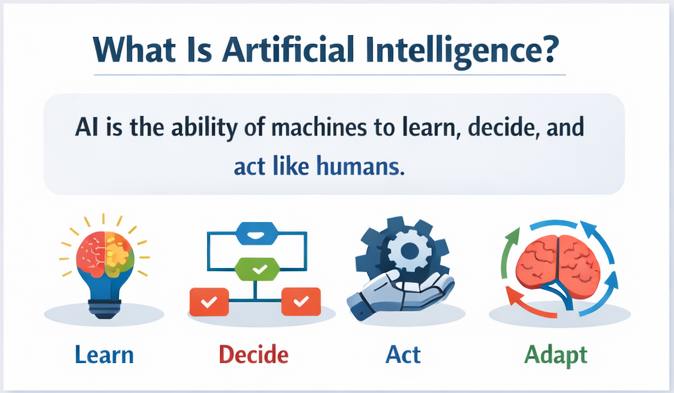
Artificial Intelligence is the ability of machines to think, learn, and make decisions like humans. AI systems learn from data and improve their performance over time.
Examples of AI in daily life:
-
Google Search suggestions
-
YouTube and Netflix recommendations
-
ChatGPT and other AI chatbots
-
Face recognition on smartphones
AI vs Machine Learning vs Deep Learning
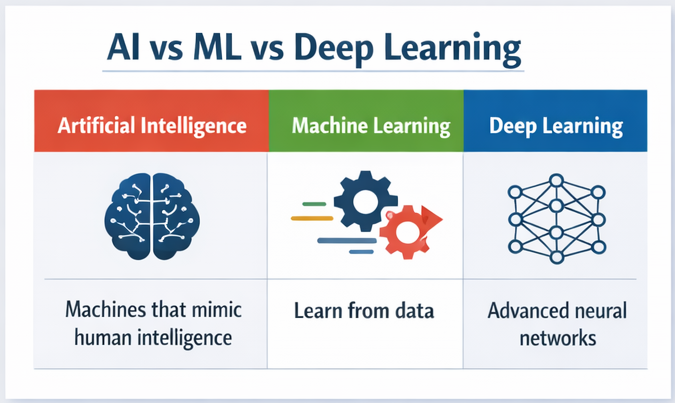
Many beginners get confused between these terms.
-
Artificial Intelligence (AI): The main concept of making machines intelligent
-
Machine Learning (ML): A subset of AI where machines learn from data
-
Deep Learning: A more advanced form of ML inspired by the human brain
| Term | Meaning |
|---|---|
| Artificial Intelligence | Machines that mimic human intelligence |
| Machine Learning | AI systems that learn from data |
| Deep Learning | Advanced ML using neural networks |
👉 Think of AI as the umbrella, ML as a branch, and Deep Learning as a deeper branch.
Who Can Learn AI?
Can Beginners Learn AI?
Yes. Beginners can learn AI by starting with fundamentals and gradually moving to advanced topics.
Can Non-Programmers Learn AI?
Absolutely. Many AI tools today require little or no coding, especially Generative AI tools.
Is AI Good for Career Growth?
Yes. AI roles are among the fastest-growing and highest-paying careers globally.
What Skills Do You Need to Learn AI?
Do You Need Coding to Learn AI?
Basic coding helps, but you can start learning AI concepts and tools without coding.
Is Math Required for AI?
Only basic math is required in the beginning. Advanced math can be learned later if needed.
Best Programming Language to Learn AI
-
Python (most popular and beginner-friendly)
-
R (used in data science)
-
Java (used in enterprise AI)
👉 Python is the best choice for beginners.
What Is the Best Roadmap to Learn AI?
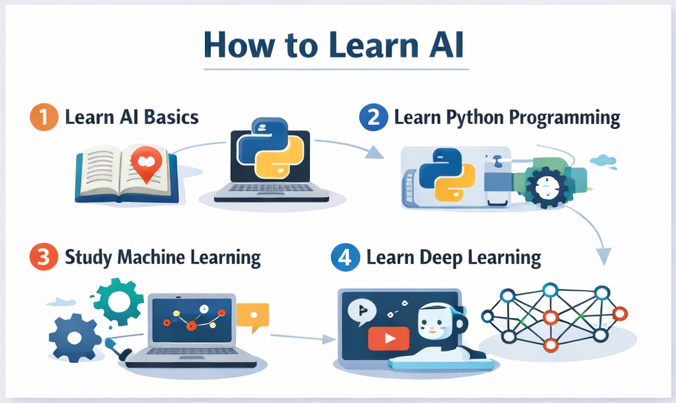
📌 How to Learn AI Step by Step
Learn the basics of Artificial Intelligence
Start learning Python programming
Understand Machine Learning concepts
Learn Deep Learning fundamentals
Explore Generative AI tools like ChatGPT
Build beginner-friendly AI projects
Step 1: Learn AI Basics
Start by understanding:
-
What AI is
-
How AI works
-
Real-world AI applications
This builds a strong foundation.
Step 2: Learn Python for AI
Python is widely used in AI because it’s simple and powerful.
Learn:
-
Variables and data types
-
Loops and conditions
-
Basic Python libraries
Step 3: Understand Machine Learning
Machine Learning teaches systems to learn from data.
Key concepts:
-
Supervised learning
-
Unsupervised learning
-
Model training and testing
Step 4: Learn Deep Learning Basics
Deep Learning is used in:
-
Image recognition
-
Voice assistants
-
Self-driving cars
You’ll learn about neural networks and deep models.
Step 5: Explore Generative AI Tools
Generative AI creates new content like text, images, videos, and music.
Popular tools include:
-
Midjourney
-
DALL·E
-
Runway ML
- Redeepseek com
This is one of the easiest and most exciting ways to learn AI.
Step 6: Build AI Projects
Projects help you apply what you learn.
Beginner AI projects:
-
Image classifier
-
Recommendation system
-
Text summarizer
Projects improve confidence and job readiness.
Best Free Resources to Learn AI
Free Online Courses
-
Beginner AI courses
-
Machine learning introductions
-
Generative AI tutorials
Best AI Tools for Beginners
-
ChatGPT for learning and practice
-
Google Colab for experiments
-
AI image and video tools
Websites and Blogs
-
Official AI documentation
-
Educational blogs
-
Research platforms
📌How Long Does It Take to Learn AI?
Learning AI basics takes around 2–3 months, while becoming job-ready in AI may take 6–12 months with regular practice.
Time Required for Beginners
-
AI basics: 1–2 months
-
Python + ML basics: 3–6 months
Time Required for Career-Ready Skills
-
Job-ready AI skills: 6–12 months
(depending on practice and consistency)
AI Career Options After Learning AI
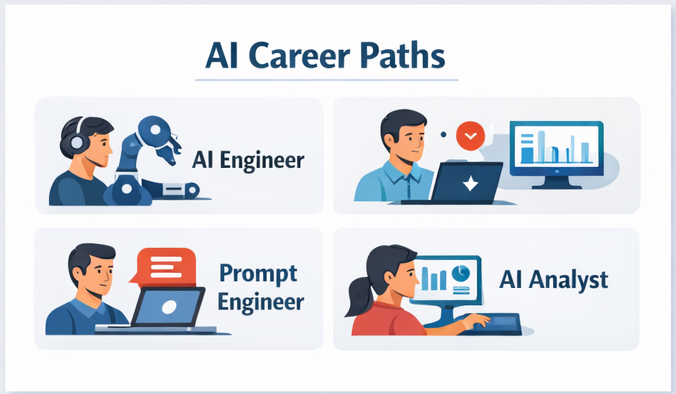
AI Engineer
Builds and deploys AI systems.
Data Scientist
Analyzes data and builds predictive models.
Prompt Engineer
Optimizes prompts for Generative AI tools.
AI Analyst
Uses AI tools to support business decisions.
Common Mistakes Beginners Make While Learning AI
Trying to Learn Everything at Once
AI is vast. Follow a structured roadmap.
Skipping Fundamentals
Strong basics lead to faster progress.
No Practical Projects
Theory alone is not enough—practice is essential.
📌 H2: Learn AI – Common Beginner Questions
Q: Can I learn AI without coding?
Yes, you can learn AI concepts and use Generative AI tools without coding, but basic Python helps for advanced learning.
Q: Is AI difficult for beginners?
AI is not difficult if you start with basics and follow a structured roadmap designed for beginners.
Q: Is AI a good career option in 2026?
Yes, AI is one of the fastest-growing career fields with high demand across industries.
Conclusion: Start Your AI Learning Journey Today
Learning AI may seem difficult at first, but with the right approach, it becomes simple and exciting. If you want to learn AI step by step, focus on basics, practice regularly, and build real projects.
AI is not just for experts—it’s for anyone willing to learn.
👉 Start today, stay consistent, and grow with AI 🚀